This year’s France World Cup will be kicking off in Paris this Friday (7), with teams from 24 countries fighting for the title of the best in the world. This will be, however, only the eighth official women’s event since FIFA decided to hold an official competition in 1991, in China. But the task to have an event such as the World Cup was not an easy one. It was only through the persistence and investment of women – and men – from different countries that turned this competition into a continuous and permanent event. For them, it was like making a dream come true.
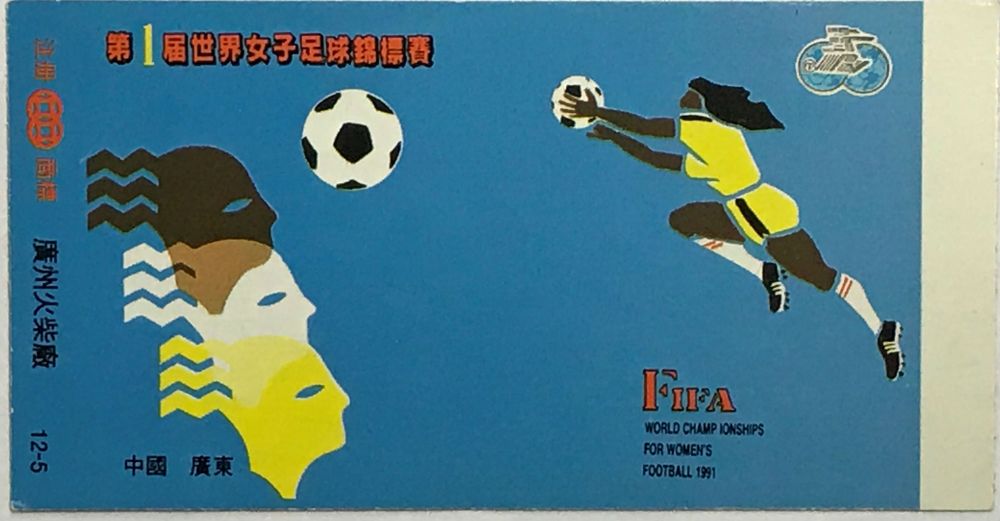
Differently from France, the first official event held in November 1991 had only 12 teams competing over fifteen days. China was the host of this first tournament, which at that time, was titled the 1st FIFA World Championship for Women’s Football for the M&M’s Cup. In the words of then FIFA president, Brazilian João Havelange, he described his view of the championship as “special”, as published on the official program. Havelange said:
“it is a special pleasure for me to watch these young ladies playing with such a flair and elegance, and according to the reports of the many media representatives present, making the game into a celebration”.
Although named the first World Cup, the 1991 event was not entirely the first women’s major international competition held in the world. Over the course of about 20 years, women from football associations in different countries had already organized themselves and prepared international tournaments around the world. It was their way of pressuring FIFA to hold a truly international event, with the same characteristics as the men’s.
As early as 1971, the first women’s football competition to be accounted for was held in Mexico, during August and September. This tournament had six teams, including host Mexico as well as Argentina, England, Denmark, Italy and France. Some of the players call that event as “the invisible world cup”, despite the attendance of over 100,000 spectators during the tournament. In the final, Denmark played against the hosts, winning 3-0 inside the Azteca Stadium. Unfortunately, the complete history of this inaugural world cup is yet to be recovered.
Later on, the second major event took place in Asia, with Taipei (Taiwan) to host the initial event in the far East in 1978, with 12 teams from four continents. Women in the Asia Pacific region organized themselves and held the 1st World Women’s Invitational Football Tournament. In the following years, two other international tournaments continued to take place in Asia, while there was no indication that FIFA would move towards the concretization of a world cup for women.
Feasibility study
In 1988, the Asian tournament held in China was finally closely observed by FIFA representatives as a feasibility study. The goal was to decide whether a competition equivalent to the men’s World Cup could be regularly established. At that time, the men’s World Cup was already in its 13th edition, with Mexico hosting the event in 1986, and then West Germany hosting the 14th edition, four years later.
The International Women’s Football Tournament had an international organizing committee, composed by members of the football world. They represented Hong Kong, China, Japan, Syria, Malaysia, as well as the Asian Football Confederation (AFC) and FIFA headquarters observers.
Over 13 days in June, the event was held in four cities, described in its official program as “intended to be a pilot project for the FIFA World Women’s Football Championship to be held in 1990”. The definition of competitors was made by invitation, selecting teams from 12 countries from four continents.
Finally 1991
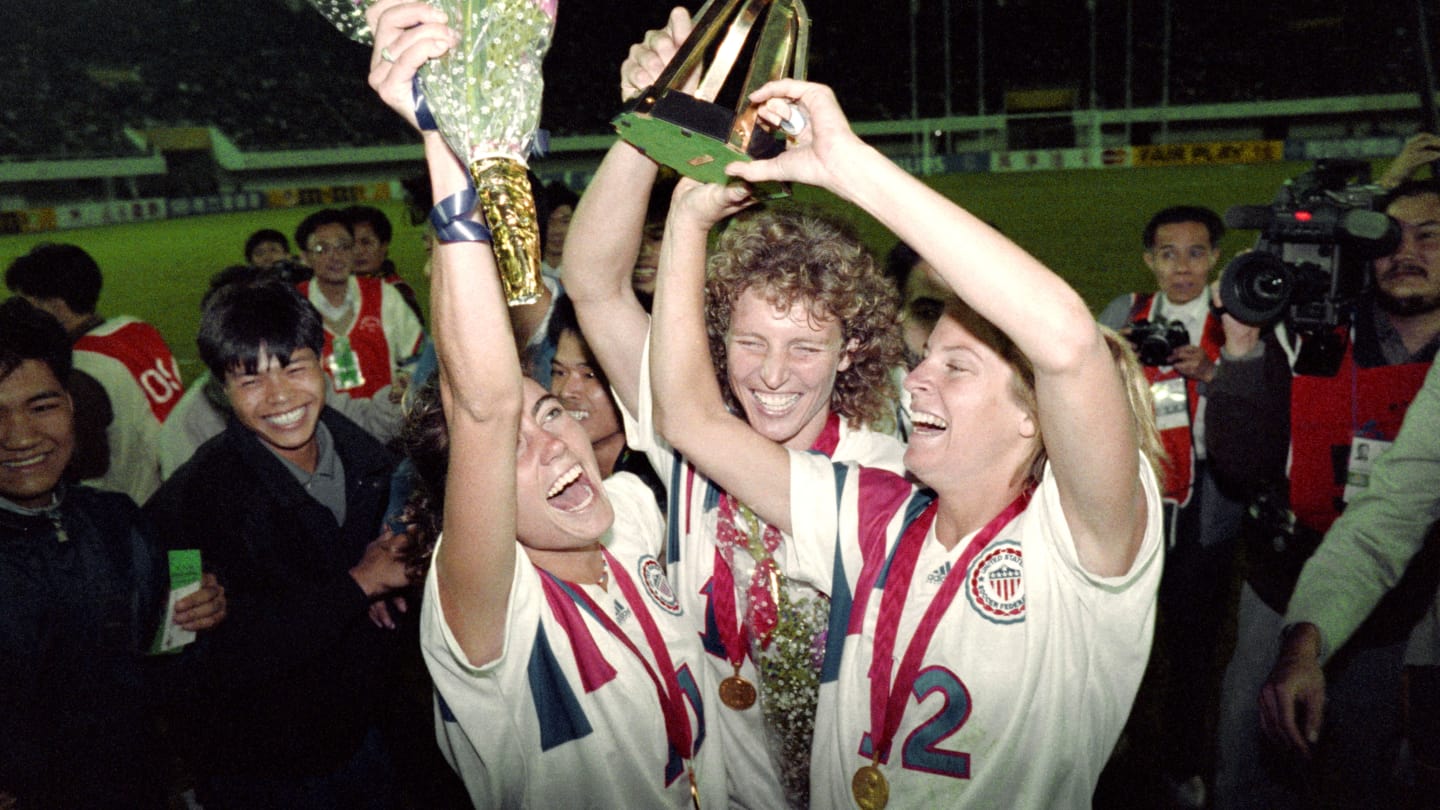
Despite the projections, high hopes and planning for 1990, the first official women’s competition held by FIFA would be only officially opened one year later in November. China’s success in hosting the pilot event gave it an automatic pass to become the host country of this first edition. FIFA was also proud to announce a number of female referees taking part in this tournament, most of them as assistant referees (lineswomen at that time). It was also when the first female referee – Brazilian Cláudia de Vasconcellos – was appointed to be in charge of the third place match.
However, even during the 1st Women’s World Championship, FIFA continued used the event as an assessment of several aspects surrounding the women’s game. Some of them can be even surprising. On the tournament program, one of the sections relates to ‘a medical point of view’ of this competition, in which the event “provided an excellent opportunity to study the fitness and stamina of the women football players, who had to play six very demanding games within fourteen days”.
On another particular point, FIFA gathered feedback from all participant teams in regards to different aspects of the competition. In their comments, most of the teams agreed that the two 40-minute halves should be kept and that the ball size 5 – standard in adult matches today – was also good in their game. Team Nigeria added particular comments:
“The 80-minute game should continue. The weaker teams are not yet ready to play 2 x 45 minutes. For many players, a lighter ball would be advantageous”.
Today, the existence of a contested World Cup for women cannot be taken for granted. The concretization of this event did not happen by chance nor without the unconditional persistence and personal investment of people from many parts of the globe. It involved women – and men – who were committed to the progress of the game in their own organizations and countries. The 2019 event in France represents also the conquering of a field in which women were initially unwelcome to, which that is unfortunately still present in some parts of the world until today.